/ 3 min read
The Fougère Returns: Perfumery Rediscovers Its Oldest Accord
There is a peculiar honesty in the fact that perfumery's most influential accord is named after something that has no smell at all. Fougère is French for fern, and ferns are all but scentless. When a perfumer speaks of a fougère, he is not describing a plant he can bottle; he is describing a mood, an abstraction, a green-aromatic reverie of forest floor and cool air that exists only in the imagination and in the composition. It is the closest perfumery comes to pure music — a chord invented rather than copied from a garden.
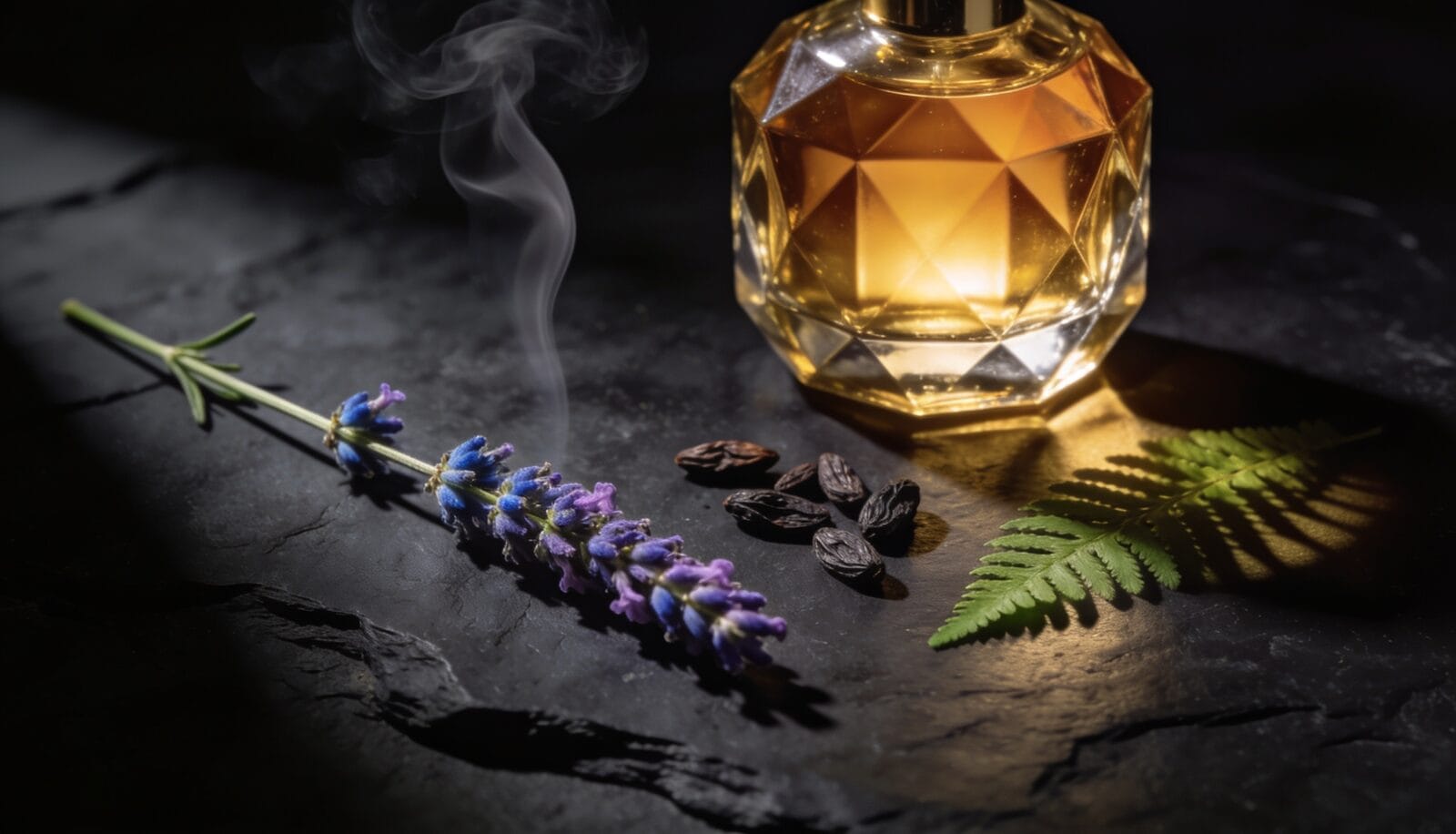
The chord was struck in 1882, when Paul Parquet created Fougère Royale for the house of Houbigant. Its genius was a then-new material called coumarin, the warm, hay-and-almond molecule that lives inside the tonka bean. Fougère Royale is remembered as one of the first fragrances to build itself around a synthetic aroma-chemical, and in doing so it did something radical: it stopped imitating nature and started composing with it. Lavender rose at the top, aromatic and clean; coumarin glowed underneath like sun-warmed hay; a floor of oakmoss gave the whole thing shadow and depth. That triangle — lavender, coumarin, moss — became the founding grammar of an entire genre.
For a century the fougère was everywhere. It is the smell of the barbershop, of shaving soap and hot towels, of a father's aftershave. It became the reflexive language of masculine perfumery, and by the 1980s and 90s it had multiplied into a thousand fresh, blue, aquatic descendants until the word itself began to feel like a cliché. Then two things thinned it further. Overexposure dulled the connoisseur's appetite, and tightening regulation on oakmoss quietly pulled the mossy floor out from under the classic structure. Stripped of its shadow, the fougère drifted toward the synthetic and the anonymous, and the niche world — busy with oud, gourmands and skin musks — largely left it behind.
Which is what makes its return so quietly thrilling. At Esxence 2026 in Milan, the largest edition of the fair yet, one of the season's defining themes was simply this: lavender came back. House after house presented lavender-forward compositions, not as nostalgia but as reinterpretation — the aromatic heart of the fougère pulled out of the drugstore and set back on the artisan's bench.
The most eloquent argument came from Jacques Fath. Le 12 Victor Hugo, created by the perfumer Jean-Christophe Hérault for the maison's Essentials collection, was conceived to mark the opening of the house's first boutique at 12 Avenue Victor Hugo in the sixteenth arrondissement of Paris. Rather than pile on the modern fougère's later accessories — the vetiver, the patchouli, the moss — Hérault went the other way, back to the very root of the genre: coumarin. He built a smoky lavender, wove through it a generous seam of tonka bean, and laid the whole thing across a base of birch tar, soft and resinous and faintly leathered. The result reads as fresh, lively, cool lavender paired with warm tonka and stretched over a slightly sweetened, tarry leather — the 1882 idea rewritten in a lower, more intimate register.
What is really being rediscovered here is not a note but a principle. The fougère was perfumery's first proof that a fragrance could be an idea rather than a portrait — that a perfumer could compose a feeling from materials that, on their own, describe nothing recognisable. To return to it now, after years of literal gourmands and hyper-real fruits, is to return to first principles: to the pleasure of an accord that means something only when its parts are heard together.
To wear a fougère in 2026, then, is a quietly sophisticated act. It is to carry a piece of perfumery's founding sentence on the skin, its lavender and hay and smoke arranged not to remind you of anything in particular, but to make you feel a place that was never real to begin with. The oldest accord has come home, and it wears its age beautifully.
Before You Commit
Read about it. Then live with it.
Order a 2ml decant of any scent in the house and wear it for a few days before you commit.