/ 4 min read
Amber: The Glow That Was Never a Single Thing
Ask ten people what amber smells like and you will get ten confident answers and no two materials. Warm, they say; sweet, resinous, a little smoky, like skin held near a fire. All of it is true, and none of it points to a single thing you could pick up and hold. This is amber’s beautiful secret, the one that separates the browser from the connoisseur: amber is not an ingredient at all. It is an accord — an invented warmth, assembled by human hands, that has never grown on any tree.
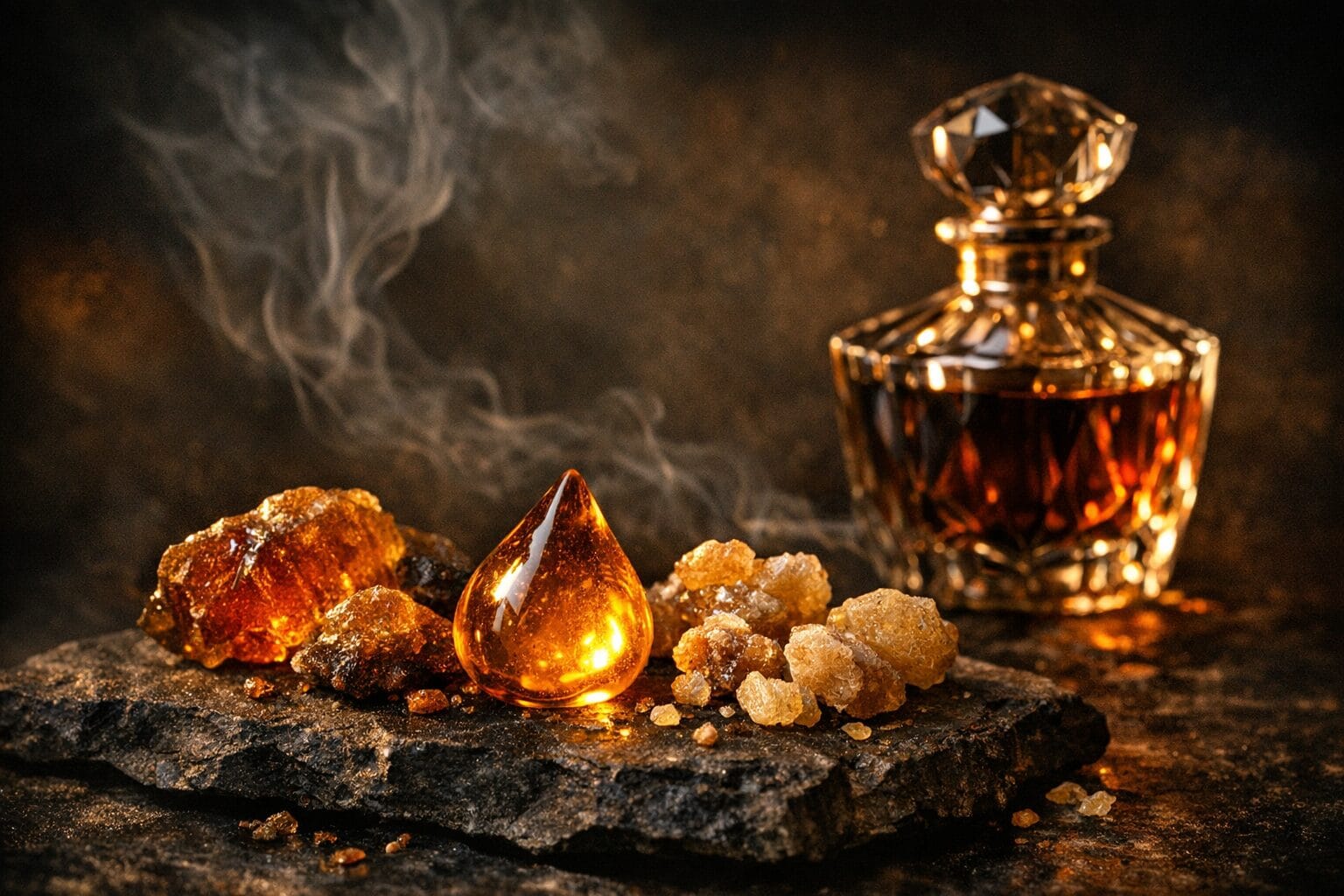
The confusion is ancient and forgivable. There is the fossil amber of jewellery, the honey-coloured stone that is really petrified resin millions of years old — and it barely smells of anything until you burn it. There is ambergris, the grey, briny concretion from the sperm whale, which is a genuine perfume material but an entirely different one. And then there is the amber of the perfumer’s vocabulary, the glow that anchors a thousand fragrances, which is neither of those. It is a fiction the industry agreed upon so completely that we forgot it was ever invented.
Pull the accord apart and you find its architecture is surprisingly stable across two centuries. At its heart sits labdanum, the dark, sticky resin combed from the leaves of the Mediterranean rockrose — a material so animalic and leathery and sweet that a single drop can suggest an entire body. Around it the perfumer builds: benzoin, the balsamic resin from a Southeast Asian tree, for its vanillic softness; vanilla itself, or its shadow, for roundness; often a whisper of styrax or tolu balsam for smoke and depth. Labdanum plus benzoin plus vanilla — that simple triangle is the skeleton of nearly every amber you have ever loved. Everything else is a house’s handwriting.
That handwriting is what makes amber endlessly re-tellable. Because it is a construction rather than a captured smell, no two ambers need agree. One perfumer leans into the leather and gives you something almost feral; another buries the labdanum under powder and resin until the result is as soft as cashmere. The word on the bottle stays the same. What changes is the temperature, the proximity to skin, the exact shade of gold — and this is precisely why amber never dates. You cannot exhaust a note that was always a decision.
In 2026, the houses are deciding in favour of warmth again. After several seasons of cool, transparent, skin-close compositions, the pendulum has swung back toward resins and the comfort of the deep base — oud, incense, benzoin, the whole amber family reasserting itself on the blotters. At Esxence in Milan this June, the most talked-about openings were built on exactly this glow: Electimuss unveiled Amber Bloom as the first chapter of its new Auras Collection, a line that reaches back to the scent rituals of ancient Rome and reinterprets them for the modern wrist. The gesture is telling. When a house wants to signal timelessness, it reaches, almost by instinct, for amber.
There is a reason the reach is instinctive. Amber is the closest perfumery comes to bottling a feeling rather than a scene. A rose transports you to a garden; a citrus to a bright morning; oud to somewhere far and ceremonial. But amber does not take you anywhere. It simply makes the air around you warmer, and closer, and a little more golden — the olfactory equivalent of low lamplight. It is the note we reach for in autumn, in grief, in intimacy, whenever we want to feel held. That it corresponds to no real substance only deepens the magic. We invented warmth, and then we learned to wear it.
For the collector, amber is the quiet test of a house’s soul. Anyone can source a beautiful jasmine; the flower does much of the work. But amber offers no shortcut. Every gram of its glow is a choice — how much leather, how much smoke, how much sweetness before the whole thing tips into candy. The great ambers, the ones that smell expensive from across a room, are the ones where those choices were made by someone with restraint and nerve in equal measure. They do not shout. They simply make everything near them feel warmer, and leave you unable to say exactly why.
So the next time a fragrance is described to you as an amber, resist the easy picture of a golden stone or a distant tree. There is no tree. There is only a perfumer, a few dark resins, and the oldest ambition in the craft: to take the cold air of a room and make it glow. In 2026, more houses than ever are returning to that ambition — and the warmth they are chasing was, all along, something we made ourselves.
Before You Commit
Read about it. Then live with it.
Order a 2ml decant of any scent in the house and wear it for a few days before you commit.